

ICP Discovery Framework: From Guesses to $519M Exit
Stop guessing your ICP. Our 4-phase experimentation framework helped us discover our real ICP and grow to a $519m exit. Actionable tactics inside.
Nov 25, 2025
Sales

Why Marketing Teams Fail at ICP Discovery (And How to Fix It With Experimentation)
Your VP of Sales just told you the leads are garbage. Again.
Your marketing team insists they're targeting the ICP. Again.
The problem? Your ICP was never right in the first place.
Most marketing teams treat ICP discovery as a one-time definition exercise, fill out a template, check a box, move on. According to research on ideal customer profile mistakes, the number one error B2B companies make is creating their ICP based on educated guesses rather than validated data. They're throwing spaghetti at the wall instead of running real experiments.
We discovered our ICP by selling to 100+ companies on the way to our $519m exit at Voxbone. Our initial hypothesis? Dead wrong. Our actual ICP looked nothing like what we'd written in the business plan. The difference between guessing and knowing was worth millions in CAC savings and faster pipeline velocity.
Here's why your ICP discovery is failing and the experimentation framework that actually works.
The real reason ICP discovery fails (it's not what you think)
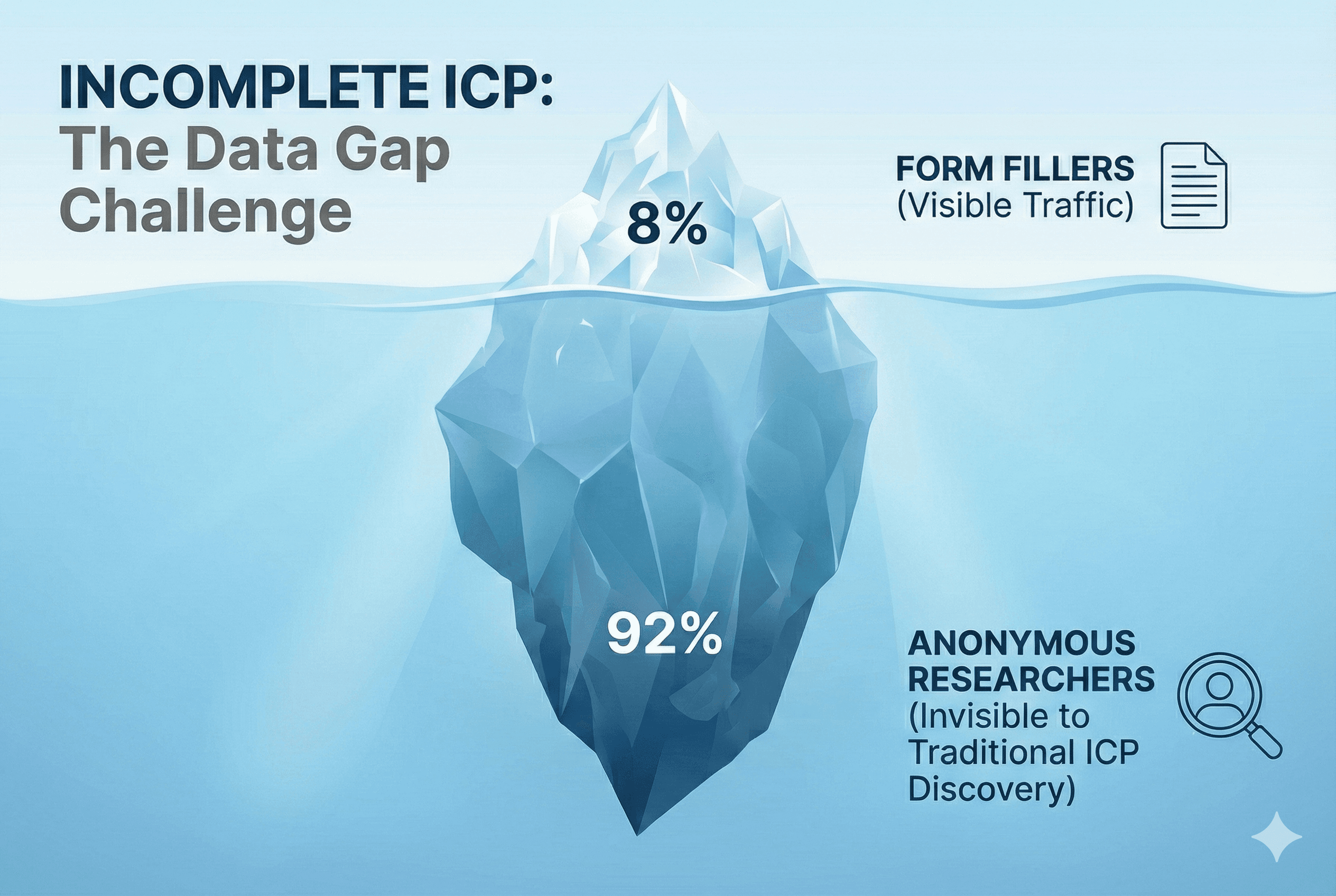
You're defining ICP based on 8% of your market
Here's the uncomfortable truth: 92% of your qualified prospects research anonymously before they ever fill out a form or talk to sales.
They visit your website 31 times over 6 months. They download case studies, browse pricing, build complete competitive evaluations. Then they either buy from you, buy from a competitor, or do nothing, and you have no idea they ever existed.
Your CRM shows "anonymous user from Chicago" while a $2.3M deal evaluates you in silence.
This is Pipeline Blindness. And it destroys ICP discovery.
When you analyze your "best customers" to define your ICP, you're only analyzing the 8% who converted through visible channels. The other 92%, including many of your best potential customers, remain completely hidden. You're defining your ICP based on form-fillers, not based on who actually evaluates and buys enterprise software.
Even worse, that visible 8% is biased toward lower-value buyers. SMB customers fill out forms because they need help fast. Enterprise buyers with 6-month evaluation cycles? They research in stealth mode because they don't want aggressive SDRs blowing up their phone.
You're optimizing for the wrong 8%.
You're confusing ICP definition with ICP discovery
Everyone talks about "defining" your ICP. Fill out the template: industry, company size, revenue, tech stack, geographic location.
But that's not discovery, that's documentation.
Discovery is the messy process of learning which companies actually succeed with your product, why they buy, how they expand, and what makes them profitable to serve. Definition comes after discovery, not before.
Most teams skip straight to definition. They document who they wish would buy their product instead of discovering who actually should buy it. Then they wonder why the leads are garbage.
The 5 fatal mistakes marketing teams make with ICP discovery
Most B2B teams approach ICP discovery with good intentions but fatal execution flaws. Here are the mistakes that will cost you millions in wasted CAC.
Making educated guesses instead of using data
"I think our ICP is probably enterprise companies in fintech."
Why? "Because they have big budgets and our product could help them."
This is educated guessing. And it's expensive.
Most B2B marketing teams create ICPs based on assumptions: who has the most budget (enterprises), who has the biggest pain (hard to know), who would we like as customers (aspirational logos).
They're not looking at which customers actually succeed, expand, and generate profit. Even when teams run A/B tests, they're measuring engagement and form fills, not whether those leads become the 20% of customers driving 80% of profits.
We learned this the hard way at Voxbone. Our initial ICP hypothesis targeted Fortune 500 enterprises with existing telecom infrastructure. Looked great on paper. Large TAM, big budgets, clear pain points.
Our data revealed the truth: those enterprises had 9-month sales cycles, demanded massive customization, rarely expanded, and churned when their vendor management processes dictated cheaper alternatives.
Our actual best customers? Growth-stage SaaS companies that started small but expanded rapidly. Expected LTV was 5x higher than initial ACV. We would have never guessed it. The data was undeniable.
Creating ICP in a marketing bubble
Marketing sits in a room, fills out the ICP template, and declares victory.
Meanwhile, sales is grinding through discovery calls learning that half the "ICP-fit" leads can't actually implement the solution. Customer success is watching accounts that match the ICP perfectly churning at 30% annually. Product is building features for a market that doesn't match marketing's target.
Research on ICP alignment challenges shows that lack of cross-department alignment leads to disparate targeting efforts, ineffective campaigns, and lower sales achievement.
Your ICP should be built with input from:
Sales: Who converts faster? Who has shorter sales cycles? Which objections are deal-breakers?
Customer Success: Who expands? Who churns? What signals predict each outcome?
Product: Which customers get to value fastest? Who actually uses the features?
Finance: Which customer segments are actually profitable after fully loaded CAC and service costs?
One department can't see the full picture. Marketing sees form fills. Sales sees close rates. CS sees expansion and churn. You need all three to understand who your real ICP is.
Confusing ICP with Total Addressable Market
This mistake manifests in ICP documents that look like this:
"Our ICP is B2B software companies with 50-5,000 employees and $5M-$500M in revenue."
That's not an ICP. That's a TAM calculation dressed up in ICP language.
Your TAM answers: How big is the opportunity if we captured everyone who could theoretically buy?
Your ICP answers: Who should we target right now to maximize win rate, deal velocity, and expected LTV?
These are fundamentally different questions. TAM is about market sizing for investors. ICP is about capital-efficient growth execution.
A properly defined ICP is narrow: "Series B SaaS companies, 100-300 employees, $15M-$40M ARR, sales-led motion, currently using Salesforce and Outreach, experiencing pipeline visibility problems."
You can build an account list from that. You can craft messaging for that. You can't do either with "50-5,000 employees."
Treating ICP as static
Most teams do the hard work of ICP discovery, document their findings, and file it away.
Two years later, the market has evolved. The product has matured. Competitors have shifted. But the ICP document gathering dust hasn't changed.
Your ICP discovery should evolve with your business. At $5M ARR, your ICP might be early adopters who tolerate rough edges for cutting-edge capabilities. At $50M ARR, your ICP shifts to buyers who value reliability and integration with existing tech stacks.
The customers who got you to $5M might not be the customers who get you to $50M. If you're still targeting the same ICP you defined three years ago, you're targeting the wrong customers.
We revised our ICP quarterly at Voxbone. Every 20 new deals taught us something about who actually succeeded with our product. Our ICP in 2016 looked nothing like our ICP in 2020, and that evolution was a major reason we hit the unit economics that led to our $519m exit.
Not creating negative profiles
Everyone focuses on who to target. Almost no one defines who not to target.
This is expensive.
Your negative profile identifies prospects who look good on paper but consistently churn, demand excessive support, or never expand. They pass initial qualification but ultimately destroy unit economics.
For us, that meant Fortune 500 enterprises with procurement-heavy buying processes. They looked like ideal customers: massive budgets, clear pain points, impressive logos. But they had 12-month sales cycles, demanded extensive customization, nickel-and-dimed us on pricing, and churned the moment a cheaper alternative emerged.
We stopped pursuing them. Our pipeline shrunk. Our CAC dropped by 40%. Our win rate doubled.
Defining who not to target is as important as defining who to target. It prevents your sales team from wasting time on deals you shouldn't win, and don't want to win.
Why traditional A/B testing doesn't work for ICP discovery
Let's address the obvious solution: "Just A/B test different ICP segments and see which converts better."
Great idea. Three problems make traditional A/B testing ineffective for ICP discovery.
The sample size problem
B2B experimentation is brutally hard. As Statsig research on B2B testing strategies explains: you're working with sample sizes that would make a consumer marketer laugh.
Consumer companies test with millions of users and days of data collection. B2B companies test with hundreds of leads and months of sales cycles. One $500k deal can skew your entire experiment.
To reach statistical significance on a 20% improvement in conversion rate, you need thousands of trials. Growth-stage B2B companies close 20-50 deals per quarter. You'd need years of data to validate anything.
The long sales cycle problem
Your sales cycles last 6-9 months. You want to test if one ICP segment converts better than another.
How long until you have results? 6-9 months minimum. And that's just to see which prospects entered your pipeline, not which actually closed and became profitable customers.
To know which ICP leads to better customer outcomes, you need to wait another 12-18 months for expansion and churn signals. You're now 18-27 months into your "experiment."
Your board wants faster results than that.
The attribution nightmare
Even if you had enough sample size and time, you still can't definitively attribute success to ICP fit.
Did that segment convert better because it's a better ICP? Or because your messaging happened to resonate more, your ad creative performed better in that demographic, your sales team closed those deals faster, external market conditions favored that vertical, or one influential buyer referred five others?
With traditional A/B testing, you can isolate variables. With ICP discovery, everything is interconnected. You can't isolate "ICP fit" from messaging, sales execution, product-market fit, and a dozen other variables.
And remember: 92% of your qualified prospects research anonymously. You have no idea which ICP segments are evaluating you right now. Your conversion data only tells you about the 8% who filled out forms.
Traditional A/B testing doesn't work for ICP discovery. You need a different approach that accounts for small sample sizes, long sales cycles, and the reality that most qualified buyers research invisibly.
The CustomerOS ICP experimentation framework (what actually works)
After selling to 100+ companies on the way to our $519m exit, we learned that ICP discovery is an experimentation problem, not a definition problem.
Here's the framework we wish we had from day one.
Phase 1: Qualitative hypothesis formation (weeks 1-2)
You can't A/B test your way to ICP clarity when you're working with small samples and long sales cycles. Effective ICP discovery starts qualitative, not quantitative.
Step 1: Identify your top 10-15 customers by expected LTV (not year 1 ACV)
Most teams analyze their biggest logos or longest-tenured customers. Wrong approach.
Look for customers with the highest [expected lifetime value through ICP-fit scoring:
Rapid expansion potential (adding seats, features, use cases)
High engagement (using the product daily, multiple stakeholders)
Low support burden (self-sufficient, not constantly escalating issues)
Referral generation (bringing others into the fold)
Don't confuse initial contract size with long-term value. A $10k customer who expands to $200k is better than a $100k customer who churns after year one.
This is the superuser identification framework we used at Voxbone. The top 20% of our customers drove 85% of revenue. Those were our real ICP, not the Fortune 500 logos we chased early on.
Step 2: Conduct 5-7 deep customer interviews (90 minutes each)
As research on B2B experimentation confirms: five in-depth customer interviews can tell you more than a month of inconclusive A/B tests.
Your interview framework:
Jobs to be done: What problem were you actually trying to solve when you bought?
Buying triggers: What changed that made you start evaluating solutions now?
Anonymous research: How long did you research before contacting us? What content mattered?
Decision process: Who was involved? What nearly killed the deal?
Expansion journey: What made you buy more? What would make you buy even more?
What you're listening for: Patterns. When 5 out of 7 customers mention the same buying trigger, pain point, or evaluation criterion, that's signal.
One customer's story is anecdotal. Seven customers telling you the same story is your ICP.
Step 3: Synthesize into ICP discovery hypothesis
Now you can document your ICP discovery hypothesis based on real patterns from successful customers:
Firmographics: Company size, revenue, industry, location (but only the attributes that actually correlate with success)
Technographics: Existing tools, tech stack maturity, integration requirements
Behavioral signals:
Buying triggers (new funding round, failed implementation of competitor, executive turnover)
Pain severity (quantified, not "they have a problem")
Budget authority (who controls the money, how procurement works)
Expected LTV indicators:
Expansion potential (multiple use cases, large addressable user base)
Use case maturity (solving growth problems vs survival problems)
Engagement patterns (daily active users, stakeholder distribution)
This is a hypothesis, not a conclusion. You're making an educated guess informed by customer patterns. Now you test it.
Phase 2: Top-of-funnel validation testing (weeks 3-6)
Why start at top-of-funnel? Because you need enough data to make decisions, and that's where your biggest audiences live.
You don't have enough pipeline to test close rates by segment. But you have enough website traffic to test engagement by segment.
Step 1: Create ICP-specific vs broad audience campaigns
Launch two campaigns:
Test group: Highly targeted to your ICP hypothesis (specific job titles, company sizes, industries, tech stack)
Control group: Broad targeting representing your current approach
Tailor messaging to each:
Test creative: Speaks directly to ICP pain points discovered in interviews
Test landing pages: ICP-specific examples, use cases, social proof
Control creative: Broad value propositions
Track engagement metrics: Click-through rate, landing page engagement, time on site, pages per session, repeat visits from ICP-fit accounts.
Step 2: Measure intent signals, not just conversions
Don't just track form fills, track engagement from ICP-fit accounts even when they're researching anonymously.
Monitor:
Which ICP-fit companies are visiting your site (even anonymously)
Content consumption patterns (do high-fit accounts binge your pricing page and case studies?)
Repeat visit behavior (how many times do they come back before converting?)
Page depth and time on site by ICP segment
If your ICP hypothesis is right, high-fit accounts should show stronger engagement even before they fill out forms. If they don't, your ICP hypothesis needs refinement.
Phase 3: Pipeline velocity validation (weeks 7-12)
Top-of-funnel engagement is one signal. Pipeline performance is the real test.
Step 1: Track pipeline metrics by ICP-fit score
Score every opportunity by how well it matches your ICP hypothesis. Then track:
Demo-to-opportunity rate: Do ICP-fit demos convert to pipeline more often?
Opportunity-to-close rate: Do ICP-fit opportunities close more frequently?
Average deal size: Larger or smaller than non-ICP opportunities?
Sales cycle length: Do ICP-fit deals close faster?
You're looking for concentration of positive signals. If ICP-fit opportunities convert better, close faster, and generate larger deals, your hypothesis is right.
If they don't, your hypothesis is wrong, but you learned that in 12 weeks instead of 12 months of blind execution.
Step 2: Get field feedback from SDRs, AEs, and CSMs
Quantitative data tells you what's happening. Qualitative feedback from your team tells you why.
Ask your revenue teams:
Do ICP-fit accounts feel genuinely easier to work with?
What objections come up with ICP-fit vs non-fit prospects?
How fast can you identify champions in ICP-fit accounts?
Are ICP-fit customers hitting value milestones faster?
As validation research from Lenny's Newsletter notes, field feedback is critical for confirming your ICP-fit accounts aren't just converting better by luck, they're fundamentally better customers.
Step 3: Refine ICP hypothesis based on closed deals
Analyze your last 20 closed-won deals. What firmographics, technographics, and behavioral signals did they share?
Compare that to your original ICP hypothesis. What did you get right? What did you get wrong?
Just as important: analyze closed-lost and early churn. What patterns do you see in customers who bought but didn't succeed? That's your negative profile taking shape.
Every cycle of 20 deals refines your ICP. After 100 deals, you'll have an ICP based on real outcomes, not educated guesses.
Phase 4: Continuous iteration (quarterly)
Your ICP isn't static. Revisit it every quarter.
Quarterly ICP discovery reviews: Analyze at least 20 recent deals. What's changed? What new patterns are emerging?
Tech stack alignment check: Are your ICP assumptions about existing tools still valid? Or has the market shifted?
Expected LTV validation: Compare predicted expansion potential to actual expansion behavior. Which customers surprised you?
Negative profile updates: Who are you attracting that you shouldn't be? Refine your negative profile to help sales avoid bad-fit deals.
At Voxbone, our quarterly ICP discovery reviews were non-negotiable. Every 20 new deals taught us something. Our ICP in year one looked nothing like our ICP in year four, and that evolution was worth millions in CAC savings and faster growth.
Real-world example: How we discovered our ICP (Voxbone → $519m exit)
Let me tell you what we got wrong about ICP discovery, what the data revealed, and how we fixed it.
Initial hypothesis (what we got wrong)
In 2016, our ICP hypothesis targeted Fortune 500 enterprises with existing telecom infrastructure. The logic seemed sound:
Massive budgets ($10M+ annual telecom spend)
Clear pain point (legacy systems, expensive infrastructure)
Established buying process (they were already purchasing our category)
Impressive logos (great for fundraising and case studies)
We went all-in. Hired enterprise AEs. Built complex product features for enterprise requirements. Crafted messaging for Fortune 500 CIOs.
Our close rate was 15%. Our sales cycles averaged 9 months. Our CAC was unsustainable. Our NRR was 95% because enterprises rarely expanded, they were locked into multi-year contracts with slow-moving procurement.
The data was screaming at us: your ICP is wrong.
What the data revealed
We ran our ICP discovery experimentation framework (before we had a formal framework, we figured it out through trial and error).
After interviewing our top 20 customers by expected LTV, patterns emerged:
Our best customers were growth-stage B2B SaaS companies (50-300 employees, $10M-$50M ARR), not Fortune 500 enterprises.
Why were they better?
Faster sales cycles: 2-3 months instead of 9 months
Lower CAC: No enterprise procurement, fewer stakeholders
Rapid expansion: They started small but 3x'd usage as they grew
Predictable growth: Their growth was our growth, aligned incentives
Lower support burden: Tech-savvy teams who didn't need hand-holding
Expected LTV was 5x higher than year 1 ACV. A customer signing at $30k annual contract value would expand to $150k+ within 24 months. Those economics were 10x better than enterprises signing $200k deals that never grew.
The kicker? These growth-stage SaaS customers had been evaluating us anonymously for months. They researched thoroughly, consumed all our content, and only converted when they were ready. We'd been ignoring them because they didn't fill out forms fast enough.
How we tested and refined
We pivoted our entire go-to-market:
Rebuilt messaging around growth-stage SaaS pain points (scaling internationally, expanding into new channels)
Launched targeted campaigns to Series A and Series B SaaS companies
Tracked pipeline velocity by segment (SaaS companies closed 3x faster)
Scored opportunities by expected LTV, not year 1 ACV
We stopped chasing Fortune 500 logos. Our pipeline shrunk initially. Our board panicked.
Then the data came in: win rate doubled, CAC dropped 40%, NRR hit 120%.
The impact on exit valuation
By 2020, when we sold for $519m, our unit economics were industry-leading:
LTV to CAC ratio: 8+ (vs target of 3)
Net revenue retention: 120% (vs industry average of 105-110%)
Customer expansion rate: 85% of revenue came from top 20% of customers
Our bankers worried about "concentration risk." We called it expected LTV-based ICP targeting. The buyers understood the difference.
That disciplined ICP discovery process, starting with qualitative customer research, validating with pipeline metrics, and iterating quarterly, was worth tens of millions in exit valuation. Maybe more.
Your ICP is worth more than you think. But only if it's based on discovery, not guesses.
The window is closing
ICP discovery isn't a one-time exercise. It's an ongoing experimentation problem that requires lead intelligence, customer research, and systematic validation.
Five deep customer interviews can tell you more than a month of inconclusive A/B tests. Qualitative research beats quantitative testing when you're working with small samples and long sales cycles. Expected LTV matters more than year 1 ACV.
These lessons took us years to learn. You can implement them this quarter.
Here's what to do next:
Interview your top 10 customers by expected LTV this week. Don't analyze your biggest logos or longest-tenured accounts, analyze the ones with the highest expansion potential.
Create an ICP discovery hypothesis based on patterns from those interviews. Look for behavioral signals, not just firmographics.
Test your hypothesis with targeted top-of-funnel campaigns. Measure engagement from ICP-fit accounts, even when they research anonymously.
Track pipeline velocity by ICP-fit score. Do better-fit opportunities actually close faster and expand more?
Iterate quarterly. Your ICP will evolve as your product, market, and company mature.
The companies building lead intelligence today will own their markets tomorrow. Those operating blind will continue chasing ghosts, wondering why the leads are garbage again.
The question isn't whether lead intelligence will define tomorrow's winners. The question is whether you'll be one of them.
If you'd like to chat about ICP discovery or anything else GTM, grab time on my calendar. Or learn more about how CustomerOS helps growth-stage teams turn anonymous traffic into ICP-qualified pipeline.
Content Marketing
GTM
Marketing Attribution
Sales Enablement Automation
Technographic Data
Firmographic Data
Contact Enrichment
B2B Intent Data
Build Vs. Buy
Identify Anonymous Website Visitors
Lead Intelligence Platform
